Root canal treatment, also known as endodontics, is a dental procedure that aims to save damaged or infected teeth that would otherwise have to be extracted. The procedure is difficult mainly because it requires using specialized equipment and incredible precision. Correctly performed endodontic treatment preserves the tooth and minimizes the risk of dental root fracture. It also ensures better post-treatment durability and protection of the tooth.
Endodontics has undergone a significant evolution thanks to the use of a dental microscope. A microscope is a tool that allows the doctor to accurately observe and manipulate the root canals of the tooth. With this precise equipment, the specialist can identify and remove all infected or damaged tissues, as well as thoroughly clean the root canals.
Microscopic root canal treatment has many benefits for both the patient and the doctor. Firstly, the microscope provides much better visibility, which allows for the accurate removal of all tissue residue and bacteria, even in hard-to-reach places. This, in turn, translates into higher treatment effectiveness and reduces the risk of infection recurrence.
A good specialist is sometimes able to carry out the entire root canal treatment procedure during one visit, although, of course, this depends on the condition of the tooth root.
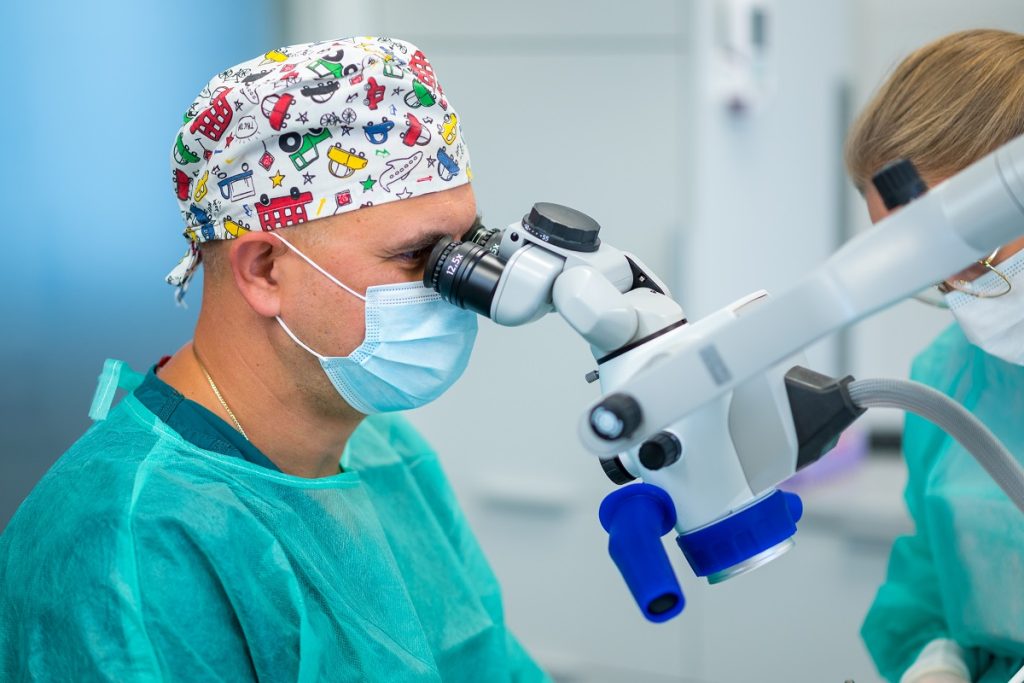
Endodontic treatments require very high precision and skill. The best specialists in endodontics work at HCentrum Stomatologiczne Jasińscy.
We treat tooth extraction as a last resort and perform microscopic root canal treatment of teeth that can be saved. We know that the whole process requires great precision, which is why we use the best equipment that allows us to maintain high-quality services and guarantees patients peace of mind for many years.
Endodontics, commonly referred to as root canal treatment, are dental procedures carried out within the root canals. Correctly conducted treatment is completely safe, although this has not always been the case. The whole procedure comes down to very precise cleaning of the canal, disinfection of the treatment area, and introduction of substitute material in the pulp, which will fix the structure in this place.
For many people, it is still a controversial procedure since without the right equipment or with careless execution, the treatment needs further corrections. Only root canal treatment procedures performed very thoroughly by an experienced physician will ensure patients can enjoy fully functional teeth. Then repeated root canal treatment will not be necessary.
Microscopic root canal treatment is available for patients of different ages and with various dental problems. Whether the root canal treatment is necessary due to a deep carious cavity, root injury, or infection, endodontic specialists will provide high-quality care and effective treatment.
Endodontic services include a wide range of procedures to treat teeth that are affected by deep carious cavities, root damages, or infections. For more advanced cases that require complex intervention, several visits are often necessary. However, it is also possible to conduct single-visit treatment when the patient’s condition and extent of damage allow it.
Often, the entire endodontic procedure usually requires several visits, but in some cases, it can be carried out during a single visit. Having previously assessed the extent of the damage and the specific needs of the patient, the doctor conducting the treatment will make an appropriate decision. Single-visit treatment is beneficial both for the patient who saves time and avoids multiple visits, and for the doctor who can focus on precise treatment in one stage.
Incorrectly performed root canal treatment exposes patients to additional discomfort. Inaccurate cleaning or filling of the canals, leaving broken dental tools in them, perforations, or secondary fracture of the crown fragment do not necessarily lead to tooth extraction. Repeated root canal treatment allows you to correct a previously unsuccessful procedure. In this case, with the help of a microscope, the doctor can accurately assess the condition of the tooth and perform a comprehensive treatment procedure, ensuring the longest durability and effectiveness.
If a tooth that has undergone root canal treatment has not been properly secured by the doctor, there is a risk of its reinfection. It is then worth performing the entire treatment procedure once again using a microscope to make sure the result’s maximum durability and effectiveness.
Nowadays, root canal treatment does not have to hurt. Various methods of local anesthesia are available, which means that most often there is no discomfort felt, and the only unpleasant moment is the administration of the anesthetic itself. Although the feeling of discomfort may appear after the anesthesia subsides, it is usually so minor that it does not hinder everyday functioning and subsides very quickly.
The progress in the field of dentistry, allows root canal treatment to be painless for patients, and modern methods of local anesthesia ensure effective pain blocking during the procedure. The dentist will carefully assess the condition of the tooth and apply anesthesia accordingly to ensure maximum comfort for the patient.
The process of administering anesthesia is usually short-lived and often the only time the patient experiences slight discomfort. However, it is worth noting that even then doctors use techniques that minimize discomfort and try to make this process as painless as possible.
Root canal treatment is performed in cases where the tooth is dead or dying, but there is no need to remove it. In such situations, if the crown of the tooth is stable and properly secured, root canal treatment may allow the patient to preserve the tooth for many years, even several decades, without additional complications.
There are several situations where root canal treatment is necessary. One of them is the death of a tooth as a result of an injury, for example as a result of a fall, impact, or other damage. In such a case, even if the tooth appears to be dead, root canal treatment can help save and restore the function of that tooth.
Another cause of tooth death may be advanced caries or a deep carious defect that has reached the pulp of the tooth. Due to poor oral hygiene, bacteria can get inside the tooth and cause inflammation of the pulp. In such a case, root canal treatment is necessary to remove the infected pulp, clean the root canals and fill them with the appropriate material.
Root canal treatment may also be necessary when the cause of tooth death is unclear. In such cases, by performing an endodontic treatment procedure, infected tissues can be removed and the further development of infection can be prevented.
As a rule, root canal treatment is not carried out during pregnancy due to the necessity to take X-rays and administer anesthetics. However, the dentist together with the patient may decide to temporarily secure the canals and postpone root canal treatment for a later date.
Definitely yes. Although, in principle, a microscope is not necessary, in practice it is the only tool that allows you to reach the smallest canals and properly clean them. This greatly increases the durability of such protection and minimizes the risk of reinfection. Considering that microscopic root canal treatment and root canal treatment without the use of a microscope are the same burden for the patient, it is definitely worth choosing the method that gives better results.
In our center, we undertake endodontics in every case in which the tooth can be saved. The use of modern equipment in our dentist’s office allows us to carry out a microscopic root canal treatment with very good chances of full success. Contact us if you prefer to keep your teeth and get a root canal treatment instead of an extraction. Book an appointment, let an excellent dentist assess the situation, and get rid of the ailment once and for all.
At HCentrum, we provide our patients with microscopic root canal treatment in Gdansk. This allows us to provide the highest quality dental care and comprehensive root canal treatment that contributes to maintaining health and a beautiful smile for longer.


HCentrum Stomatologiczne Jasińscy is a member of the prestigious organization, Leading Implants Centers, which brings together the best implant offices in Europe.